

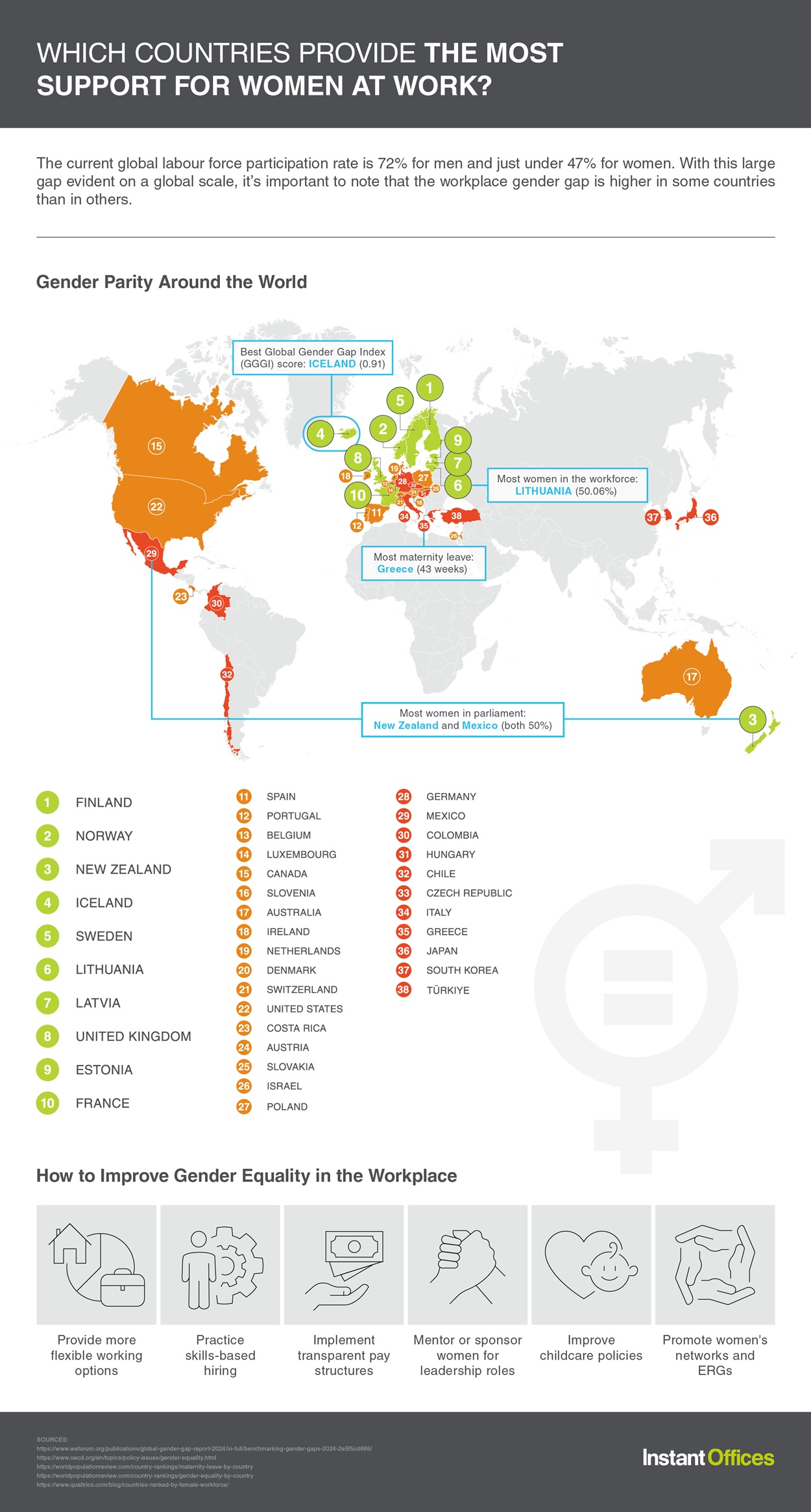
The current global labour force participation rate is 72% for men and just under 47% for women. With this large gap evident on a global scale, it’s important to note that the workplace gender gap is higher in some countries than in others. So, which countries around the world are currently the best places to be a woman in the workforce?
We collected data on 38 OECD* countries, looking at gender parity by economic participation and education, the percentage of women in parliament, maternity leave, percentage of women in the workforce, and overall gender equality in each country.
To get our leader board, each category was scored separately and combined into a final ranking score. Let’s take a look at the results.
Finland, Norway and New Zealand are Among the Best Countries for Women at Work
| RANK | COUNTRY | FINAL SCORE |
| 1 |
Finland |
136 |
| 2 |
Norway |
136 |
| 3 |
New Zealand |
134 |
| 4 |
Iceland |
124 |
| 5 |
Sweden |
123 |
| 6 |
Lithuania |
112 |
| 7 |
Latvia |
110 |
| 8 |
United Kingdom |
107 |
| 9 |
Estonia |
106 |
| 10 |
France |
105 |
According to our rankings, Finland and Norway are the #1 countries in the world for working women. New Zealand follows close behind at #2.
- Both Finland and Norway were ranked in the top 3 of The World Economic Forum’s Global Gender Gap Index (GGGI) for 2023, with a score of 0.86 and 0.88 respectively.
- Finland and Norway both have a high percentage of women making up their national workforce (48.48% in Finland and 48.83 in Norway).
- Finland and Norway also boast strong female representation in parliament, with 45.5% in Finland and 46.2% in Norway.
- New Zealand has 50% female representation in parliament and a female workforce of 47.66%.
Looking at the top-scoring countries, here are some standout statistics that our research revealed:
The United Kingdom offers the most maternity leave after Greece, with Statutory Maternity Pay lasting 39 weeks.
While the UK also scored well in terms of gender parity by educational attainment, the country’s economic participation and gender equality scores were relatively low – although the country still scored well enough to make it into our top 10.
- New Zealand and Mexico have the highest percentage of women in parliamentary positions, at 50% each.
- Iceland was awarded the best GGGI score by the World Economic Forum, with a score of 0.91.
- Lithuania has the highest percentage of women in the workforce, at 50.06%.
Countries with the Biggest Gender Disparities
On the other end of our list, the OECD countries with the biggest gender gaps and lowest gender parity are Italy, Greece, Japan, South Korea and Türkiye. These countries all had a GGGI score of 7 or lower.
- Despite Greece offering the most maternity leave (43 weeks), the country had one of the lowest GGGI ratings at 0.69.
- Greece also scored relatively low on gender parity by economic participation (0.68) and percentage of women in the workforce (44.68%).
- Türkiye has the lowest percentage of women in the workforce, at just 32.67%.
- Türkiye also has the lowest gender parity score by economic participation at 0.507.
- Japan has the lowest percentage of women in parliament at 10%.
Closing the Gap: How to Improve Gender Equality in the Workplace
Here are a few ways you can help to lessen the gender gap and improve gender equality in your workplace:
- Provide more flexible working options
- Practice skills-based hiring when recruiting employees
- Implement transparent pay structures
- Mentor or sponsor women for leadership roles
- Improve childcare policies and offer childcare support
- Promote women’s networks and Employee Resource Groups (ERGs)
More now than ever before, it’s important to prioritise community in the workplace. 85% of workers say they are more productive in a workplace that feels like a community. This is especially important for women, who may feel isolated or worried right now with the scrapping for diversity and inclusion jobs in the USA.
Improved Flexibility is Key
According to the International Labour Organization, the persistent challenges holding women back from participation and progression in the workforce include:
- Struggles with work-family balance
- Lack of transport
- Lack of affordable childcare
This clearly shows that more flexibility in the workplace – including remote and hybrid working arrangements – can go a long way toward closing the gender gap. Contact instant to find out more about flexible and hybrid office spaces in your city.
*The Organisation for Economic Co-operation and Development
Looking for Office Space?
We Operate in Some of the World’s Top Cities:
London, New York, San Francisco, Paris, Singapore, Hong Kong, Search more locations