

During your working life, you can expect your skills and value to increase with age and experience. It makes sense that your salary expectations should follow the same trajectory.
Of course, plenty of other important variables will influence how much you earn throughout your career – from the industry you work in to the state you live in.
Here’s what you need to know:
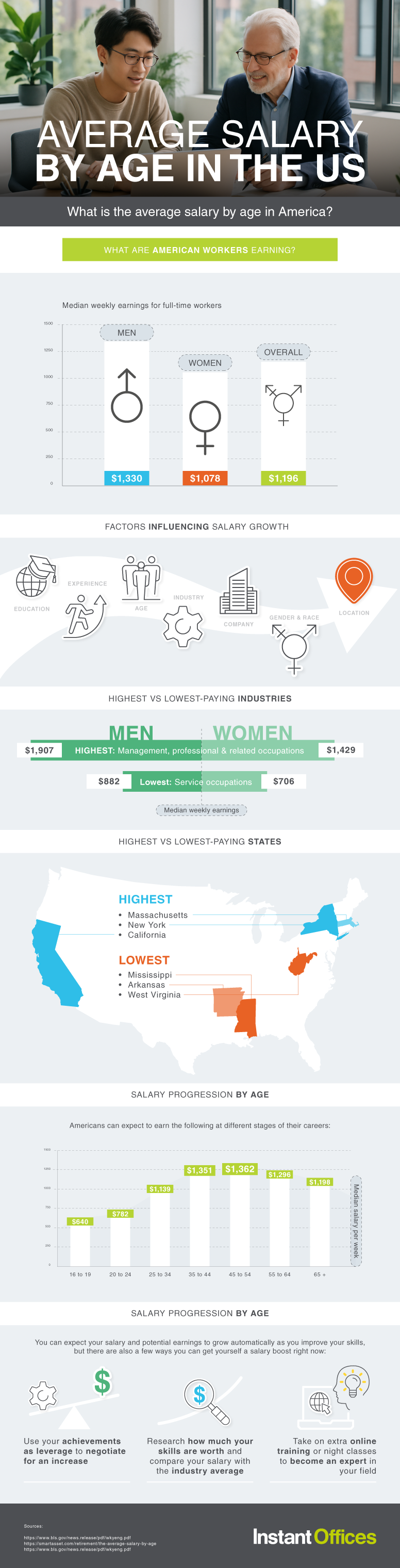
Average Salary in the US
The latest data from the Bureau of Labor Statistics (BLS) shows the following salary trends for the second quarter of 2025:
- The median weekly earnings of full-time workers in the USA are $1,196.
- Women are earning just 81.1% of this median compared to men ($1,078 weekly compared to $1,330 weekly).
- The women’s-to-men’s earnings ratio varied by race and ethnicity.
- Full-time Hispanic workers earned less ($947) than their Black ($991), White ($1,225) and Asian ($1,553) counterparts.
- Those working in management, professional and related occupations had the highest median weekly earnings ($1,907 for men and $1,429 for women).
Factors that Influence Salary Growth for 2025
These are the main factors that you can expect to influence how much you earn at different stages of your working life.
Education:
A good qualification from a respected institution will help you to start at the higher end of the salary scale. According to the BLS, college graduates with advanced degrees are earning as much as $5,346 a week, while full-time workers with bachelor’s degrees are making $1,732 and those with no college qualifications are earning just $960 weekly.
Experience:
With each year you spend in a particular role, sector or industry, you can expect to develop your skills and knowledge, increasing your salary potential alongside these.
Age:
Age and experience will increase together throughout your career. We’ll discuss age and earnings in more detail later in this post.
Industry:
Salaries vary across different industries around the US, depending on the level of skill and education required for each job. For example, while those in management positions have the highest median weekly earnings, workers in service occupations currently earn the least, at $882 for men and $706 for women.
Company:
Whether the company you work for is big or small, and whether it has a traditional or progressive culture will also affect what you earn there.
Gender and race:
Women of all ethnicities are earning less than their male counterparts across the board:
- White women currently earn 81.1% as much as white men
- Black women earn 89.5% as much as Black men
- Asian women earn 77.5% as much as Asian men
- Hispanic women earn 87.6% as much as Hispanic men
Location:
Average income will also vary depending on where you’re based. For example, Forbes lists Massachusetts, New York and California as the highest-paying states, while Mississippi, Arkansas and West Virginia are at the lowest end of the spectrum.
What should you expect to earn at your age?
Teens and Twenties:
While teenagers are in the lowest salary group, working a summer job can help you to save up towards further studies. The median salary for 16-19-year-olds in America is $679 per week, which adds up to $35,308 per year.
Employees and job hunters in their twenties can use their skillsets and education as solid motivating factors for more money. The median salary for 20-24-year-olds in the USA is $784 per week, which totals $40,768 per year.
There’s a significant jump from the early to the late twenties, with Americans aged 25-34 earning a median salary of $1,136 per week ($59,072 per year). Of course, your salary at this age will also depend on some of the other factors listed above.
Thirties and Forties:
The BLS shows that median weekly earnings are highest for men and women aged 35 to 64.
| Age Group | Weekly median earnings (men) | Weekly median earnings (women) |
| 35-44 | $1,502 | $1,190 |
| 45-54 | $1,520 | $1,189 |
| 55-64 | $1,417 | $1,134 |
Fifties, Sixties and Beyond:
Americans aged 55-64 can expect to earn a median of $1,296 per week ($67,392 per year). The workforce typically also becomes smaller as employees in this group reach their early sixties, becoming eligible for Social Security benefits.
Those who are still working full-time at the age of 65 and older typically earn an average of $1,198 per week, or $62,296 per year.
3 Ways to Boost Your Earnings in 2025
You can expect your salary and potential earnings to grow automatically as you improve your skills, but there are also a few ways you can get yourself a salary boost right now:
Demonstrate why you deserve a pay rise
Use your achievements at work as leverage when negotiating a salary increase.
Research and compare your salary
Find out how much your skills are worth and compare your salary with the average in your industry.
Become an expert
Take on extra online training or night classes to become more knowledgeable in your field. Keep learning and growing, and you can expect to enjoy better levels of success (and compensation) at every stage of your career.
Does more pay translate to higher job satisfaction?
While earning well is an important part of overall job satisfaction, it’s not always the thing employees want the most.
A recent Gallup survey showed that a scary 50% of American employees have intent to leave, saying that they are “watching for or actively seeking a new job”.
Emotions are also being tracked, with the survey also showing that 22% of employees experience emotions like sadness and with a whopping 50% saying they experience stress daily.
Despite the above statistics, 52% of employees feel that they are thriving, which creates a majority share when compared to those who feel they are struggling (44%) and those who say they are suffering (4%).
Employees wanting engagement and cultural changes listed the following improvements they would make to their workplace:
- Recognition for contributions
- More approachable managers
- More autonomy
- The opportunity to learn new things
- More respect
- Fair promotion opportunities
- Clearer goals and stronger guidance
While better pay can certainly help to motivate employees, it won’t solve problems around engagement or company culture. According to Gallup, annual engagement rates have dropped from 32% to 31% in recent statistics.
How flexibility contributes to employee engagement and wellbeing
Flexible work arrangements (FWA) have been shown to reduce stress, improve employee wellness and drive better levels of engagement. If you’re looking to adopt a more flexible way of working, there are plenty of flexible office space options available to make the transition a smooth and affordable process. Speak to the specialists at Instant about what your business needs, and we’ll help you find the ideal workspace solution for you and your team.
Looking for Office Space?
We Operate in Top US Locations:
New York, Houston, Dallas, Miami, San Francisco, Chicago,
Search more locations