
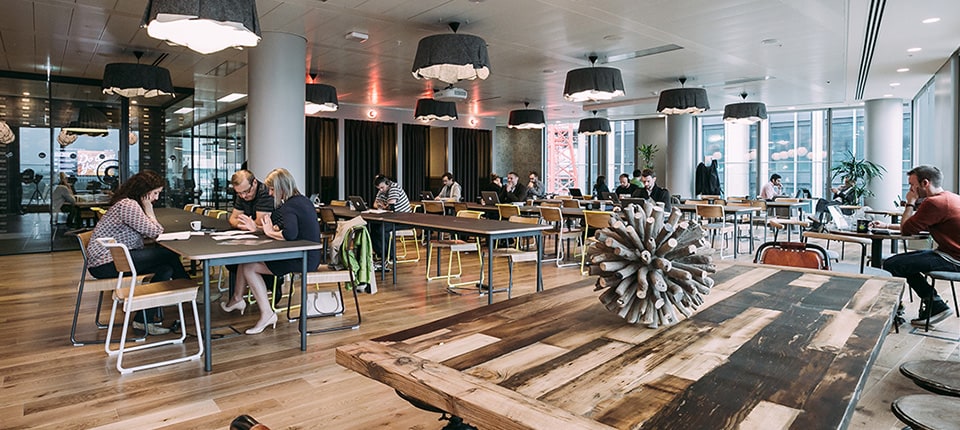
Co-working has accrued untold column inches in the past year – spaces offering co-working have undergone double-digit growth across the US and what we term “combination centres”, or a hybrid model offering both executive suites and co-working spaces, have expanded by 12.9 per cent in the last year alone. But what exactly is co-working and how is it being used by occupiers of all sizes?
Co-working has seized the corporate imagination, fuelling a vision of collaborative workspace which facilitates the cross-pollination of ideas and new ways of working. Broadly speaking, co-working refers to a business practice which involves a shared office environment for workers from different organisations.
The development in this area has been driven in part by the growth in the contingent workforce and start-ups, as it provides a cost effective route to office space. It is lucrative to operators as they charge several times over for the same space, and for occupiers it appears to create a lively, “buzzing” environment. More to the point of this piece, co-working has become a popular flexible alternative to taking conventional office space.
Instant’s research of the US market demonstrates that the co-working model differs radically across the country. In the more established flexible workspace markets – such as New York, Los Angeles and San Francisco – the term refers to the model described above and is driven by collaboration and a sense of community. While this form of co-working is growing elsewhere in the US, workspace operators are also using co-working to describe more conventional private office space with breakout areas for occupiers to meet and work more flexibly if they choose.
The vertigo-inducing ascent of WeWork to become a global brand valued at $10billion, within just 3 years, has been a key component of the co-working trend. According to deskmag.com the global co-working market has increased by nearly 300% in just five years and WeWork’s growth from New York to five additional countries around the world has been a key driver of this.

However, much as co-working in the US does not always involve collaboration between occupiers and is sometimes more similar to the traditional European serviced office market, WeWork’s provision of space has varied to become more similar to the conventional office model. This means the introduction of more private space and allocation of offices to corporate occupiers.
What WeWork has done is alter the occupier perception of traditional office provision, which has led SMEs to enquire after co-working space, seek out collaboration and drive more demand for flexible space provision by occupiers. The conventional concept of office space is starting to shift in terms of how you procure it, pay for it and occupy it.
For more information on the US flexible workspace market, check out our US flexible office space review.