

Most people believe they should be happy at work but the reality doesn’t always match up. One UK survey found that while 94% believe it’s possible to be happy at work most of the time and 87% say work should be more than just a paycheque, only 23% admit they’re currently thriving.
Click/tap to enlarge
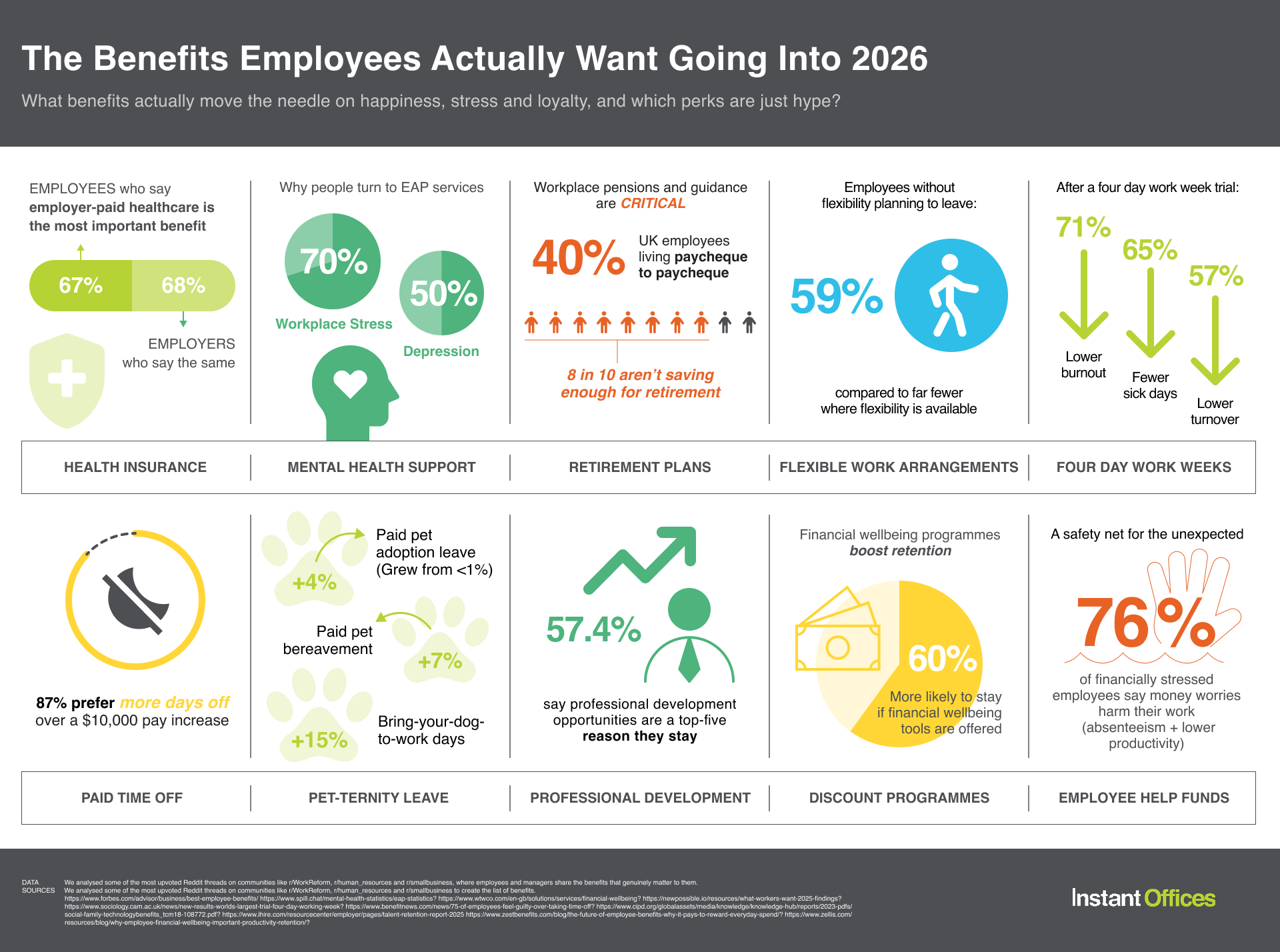
Almost 9 in 10 say their happiness at work affects their mood at home. Expectations are rising too: nearly half say their expectations of work wellbeing are higher than a year ago, and around two-thirds believe their employer should lead on creating a positive work environment.
So what benefits actually move the needle on happiness, stress and loyalty, and which perks are just hype?
To find out, we analysed some of the most upvoted Reddit threads on communities like r/WorkReform, r/human_resources and r/smallbusiness, where employees and managers share the benefits that genuinely matter to them.
The top 10 most mentioned benefits:
- Health insurance
- Mental health support
- Retirement plans
- Flexible work arrangements
- Four day work weeks
- Paid time off
- Pet-ternity leave (time off for new pets)
- Professional development
- Discount programs
- Employee help funds
Health insurance: security before perks
On Reddit, health insurance is consistently the most upvoted must-have – good cover, not just the cheapest option, and ideally including dental and eye care. And it matches what wider surveys are seeing. One study found that roughly two-thirds of employees (67%) and employers (68%) rank employer-paid healthcare as the single most important benefit at work.
How to implement it:
- Prioritise solid core cover (including mental health, dental and optical where possible) over other perks.
- Ensure transparency about excesses, waiting periods and exclusions, so people know they can actually use the benefit.
- Use a broker to tailor affordable group schemes, health cash plans or blended options rather than big corporate packages.
Mental health support: from stigma to real support
Mental health days and accessible counselling come up again and again. In 2024, around 79% of employees reported moderate-to-high stress levels, and 63% showed signs of burnout. When support is available, people use it. One analysis of Employee Assistance Programmes (EAPs) found that 70% of users accessed them because of workplace stress, and over half cited depression as a reason.
How to implement it:
- Allow mental health as a valid reason for sick leave and train managers to back that up.
- Provide EAPs, counselling, coaching or therapy, ideally with a few free sessions per year.
- Equip managers with basic mental health literacy so people don’t feel they have to hide burnout.
Retirement plans: long-term peace of mind
This is becoming more important as financial pressure rises. Data shows that many employees are deeply concerned about financial security and retirement readiness, and increasingly see retirement benefits as part of that safety net. In the UK, about 40% of employees are living paycheque to paycheque, and 8 in 10 aren’t saving enough for retirement, making workplace pensions and guidance even more critical.
How to implement it:
- Offer contributions above the legal minimum where possible.
- Make it easy for people to understand and adjust their pension contributions.
- Explore simpler schemes with professional advice.
Flexible work arrangements: how, where and when work happens
Work-life balance is now more important than pay as a top job motivator, especially as more Gen Z employees move up the career ladder, and flexible hours and remote or hybrid options are repeatedly described as life-changing. One report found that 59% of employees without flexibility plan to leave within a year, compared with far fewer where flexibility is available.
How to implement it:
- Offer hybrid models with clear expectations, rather than ad-hoc.
- Allow flex-time in the day for school runs, caring responsibilities or commutes.
- Review roles to identify where genuine flexibility is possible, instead of defaulting to office-first policies.
Four-day work weeks: less time, better results
The Four day work week has already moved from fringe idea to real-world pilot. The UK’s largest four-day-week trial, involving 61 companies and around 2,900 workers, cut working hours by 20% with no loss of pay. As a result, 71% of employees reported lower levels of burnout, sick days fell by around 65% and staff turnover dropped by 57%.
How to implement it:
- Run a time-limited pilot (e.g. six months) with clear productivity metrics, rather than a permanent overnight change.
- Use a 100–80–100 model: 100% pay, 80% time, 100% productivity.
- Invest in process improvements (automation, meeting hygiene, focus time) so reduced hours don’t simply mean compressed stress.
Paid time off: time people really feel free to take
Global surveys show paid leave sits just behind health and retirement as one of the most important benefit categories for employees. Other research has shown that 87% of employees would prefer more days off over a $10,000 pay rise, underlining how highly people value rest.
How to implement it:
- Set clear minimum expectations (“we expect everyone to take at least X days a year”).
- Track who isn’t taking leave and encourage them to book time off, particularly in high-pressure roles.
Pet-ternity leave and pet-friendly policies
Paid time off for a new pet might sound niche, but it taps into a real shift: pets are family for many employees. One survey shows that while still a minority, paid leave to adopt a pet in the UK grew from less than 1% of employers to around 4%, with 7% offering paid pet bereavement leave and 15% running “bring your dog to work” days. There’s also a productivity angle. A Wagmo survey found 75% of pet owners missed at least one day of work in a year due to pet-related issues, with over a quarter missing six or more days.
How to implement it:
- Offer a small number of pet-related leave days (for adoption, settling-in, or serious illness) where it suits your workforce.
- Consider pet insurance discounts, pet-care partnerships or pet-friendly office days as part of a wellbeing or return-to-office strategy.
- Be mindful of colleagues with allergies or phobias, and design pet policies with clear boundaries.
Professional development: growth as a benefit
Tuition reimbursement and “professional improvement budgets” are rated very highly, especially where the employer funds meaningful qualifications. iHire’s 2025 report found professional development opportunities among the top five factors keeping employees in their current organisation (57.4%).
How to implement it:
- Create a clear learning budget per person (even if modest) for courses, conferences, books or tools.
- Offer tuition support for role-relevant qualifications, with simple, fair rules about repayment if people leave soon after.
- Make career paths visible: internal mobility, mentoring and stretch projects can be as powerful as external courses.
Discount programmes and financial wellbeing
When it comes to employee benefits, people often mention grocery cards, travel discounts and retailer vouchers as small but meaningful benefits that help with day-to-day costs. This fits into a broader shift towards financial wellbeing. Around 60% of employees are more likely to stay with an employer that offers financial wellbeing programmes, such as cashback or flexible pay tools. Discount platforms, reloadable cards and cashback schemes won’t solve structural pay issues, but they can stretch salaries further and reduce money stress.
How to implement it:
- Offer discount portals or reloadable cards for groceries, fuel, travel and retail.
- Combe discounts with financial education or guidance, so people can make better use of all their benefits.
- Communicate these schemes clearly, many employees never log in, simply because they don’t realise the potential savings.
Employee help funds: a safety net for the unexpected
Employee help funds are small internal grants or loans that support people through emergencies (unexpected bills, bereavement, housing issues). Given the financial context, there’s a strong case for these safety nets. Around 76% of financially stressed employees say their money worries negatively affect their work, contributing to absenteeism and lower productivity. Financial wellbeing research shows that money worries can seriously damage mental health, sleep and overall performance. A small, well-governed help fund can make the difference between an employee spiralling into problem debt or staying afloat during a crisis.
What this looks like in practice
- Create a modest hardship fund with clear criteria, anonymised applications and simple governance.
- Pair financial support with signposting to impartial debt or budgeting advice.
- Measure impact qualitatively (stories, feedback) as well as quantitatively (retention, absence patterns).
Bringing benefits and workspace together
When you look across all ten of these benefits, a pattern emerges: people want security, time, flexibility and room to grow – not just flashy perks. That isn’t just a “HR problem”; it’s a workplace design and location question too. The way your teams use the office, how often they’re there, what they do when they come in and how supported they feel in between all shape whether those benefits really land.
At Instant Offices, we help businesses align their workspace with the way their people actually want to work – whether that’s a hub for two days a week, a network of local offices to cut commutes, or a pet-friendly space with wellbeing-led amenities. As you rethink benefits for 2026 and beyond, rethinking the role of the office is the natural next step.
If you’re exploring how flexible workspace could support better benefits, happier teams and a more resilient business, our experts can help you compare options and find a solution that fits your people, your budget and your plans for growth.
Looking for Office Space?
We Operate in Some of the World’s Top Cities:
London, New York, San Francisco, Paris, Singapore, Hong Kong, Search more locations